Millions invested in scalable quantum computing from Saxony
TGFS Technologiegründerfonds Sachsen is investing a seven-figure sum in SaxonQ GmbH. The Leipzig-based deep-tech start-up develops mobile quantum computers based on diamond chips and NV centers that can be operated at room temperature.
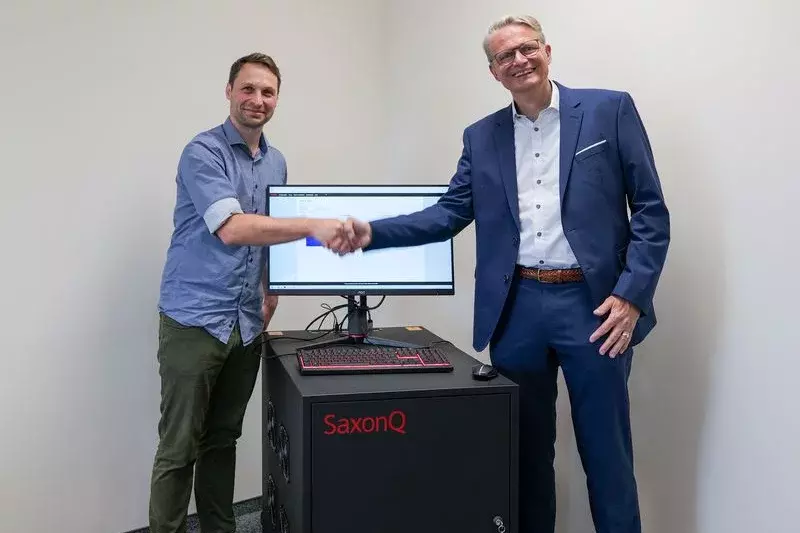
SaxonQ is thus addressing one of the biggest barriers to entry in quantum computing: reliable, industrial-grade use outside of highly specialized laboratory environments. With this investment, TGFS is providing targeted impetus for the next phase of SaxonQ, strengthening a local deep-tech company in the development and scaling phase. In parallel, SaxonQ is working on a larger capital round to miniaturize its technology to chip size and develop the necessary production technology, such as single-ion implantation.
SaxonQ was founded in 2021 by Prof. Dr. Marius Grundmann and Prof. Dr. Jan Meijer from the University of Leipzig. Today, the company is managed by Prof. Marius Grundmann and Dr. Frank Schlichting, an industry-experienced CEO with extensive management responsibility in the IT, semiconductor, automotive and energy sectors. The combination of scientific expertise, management experience and already delivered quantum computing products shows that SaxonQ is already in a position to effectively drive the industrial application of quantum computing in a rapidly growing market.
"Our technology significantly lowers the barriers to entry for the use of quantum hardware and can be a real game changer for applications in AI, logistics or medical research. The first systems are already in productive use, including at Fraunhofer IWU and the German Aerospace Center. And the scientific environment here in Leipzig, the cradle of quantum mechanics, couldn't be better for advancing quantum technologies with the best minds," explains Prof. Marius Grundmann.
Dr. Frank Schlichting adds: "Quantum computing is already a reality. We were probably the first company to demonstrate real applications ranging from quantum chemistry to image processing live at the Hannover Messe. The commitment of the TGFS shows the confidence in our team and our roadmap: The goal is the first chip-sized quantum computer, scalable and variably usable for broad industrial applications. TGFS and SaxonQ share a common vision regarding the importance of quantum computing as a key technology far beyond Saxony, so that we were able to complete the investment in the shortest possible time, pragmatically and in a goal-oriented manner."
SaxonQ develops and produces compact, mobile quantum computers that can be operated at room temperature - a key unique selling point. Conventional quantum computers require extreme cooling down to -273 °C, ultra-stable laboratory environments and a specialized, complex infrastructure. This leads to high investment and operating costs, limited mobility and difficult integration paths into existing process chains. In addition, instability, susceptibility to vibration and complex calibrations pose major hurdles to reliable use in real production or application environments. SaxonQ addresses these challenges with its advanced NV technology. Here, the qubits, the computing units of the quantum computer, are stably installed in diamond chips. The system works without cooling at room temperature and enables robust performance even outside of laboratories. The compact, mobile unit, which will be continuously reduced in size over the coming years, can already be operated in any office via a standard power socket.