High-performance computers at TU Dresden provide district heating for Dresden
Dresden’s district heating is to be generated in a climate-friendly, carbon-neutral manner through the gradual implementation of various technologies. One of these technologies is the use of waste heat, which is being implemented for the first time at the Dresden University of Technology (TUD).
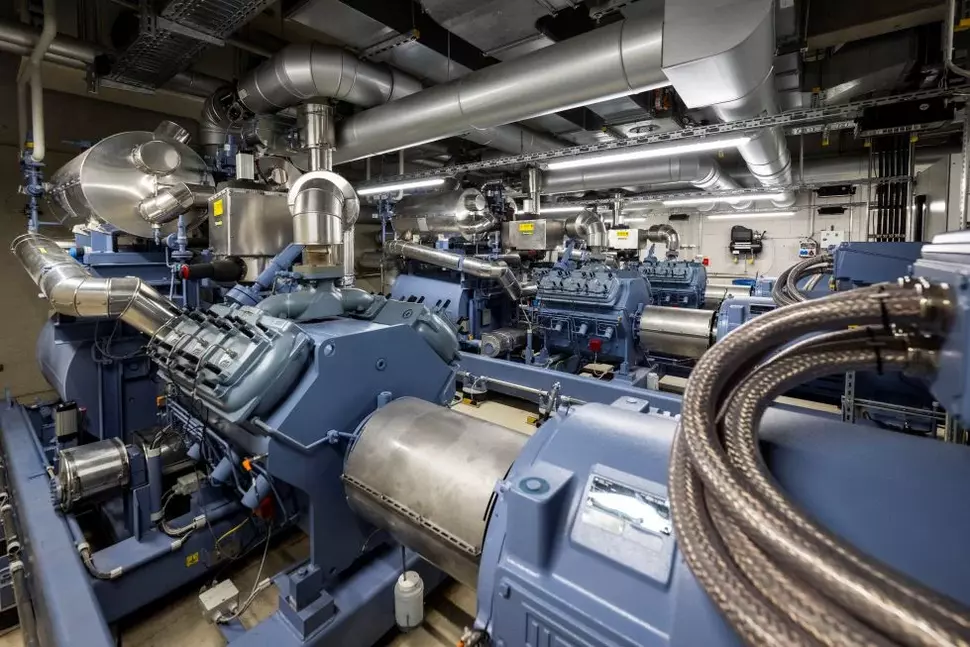
Three large heat pumps with a total capacity of 3.9 megawatts convert the excess waste heat from the high-performance computers at Dresden University of Technology (TUD) into district heating. This generates up to 24,000 megawatt-hours of green heat per year, enough to supply 3,700 average households in Dresden. Compared to conventional district heating generated with gas, this technology avoids the emission of approximately 2,700 tons of CO2. Since 2023, the state-owned enterprise Sächsisches Immobilien- und Baumanagement (SIB), the municipal utility SachsenEnergie, and TUD have jointly implemented one of the first waste heat projects of its kind in Germany.
For Dresden, the capital of Saxony, this is an innovative step toward a climate-neutral heat supply. SachsenEnergie currently operates three large-scale heat pump systems in Dresden. What makes the data center’s waste heat special is that this usable heat is available year-round. “This gives us a constantly available heat source for Dresden’s district heating networks,” says Dr. Axel Cunow, CEO of SachsenEnergie, adding: “With the operation of the heat pump system, we are taking another decisive step toward making Dresden’s district heating greener. The project demonstrates that the heat transition can only succeed through collaboration—with innovative technology and strong partners. In such flagship projects, innovation also means constantly learning, adapting, and optimizing.”
The technical structure for the heat pumps and the civil engineering work for the utility corridor were constructed under the direction of the SIB Dresden II branch. In addition to safety, power density, and high availability, energy efficiency was also a key design goal in the planning of the TUD data center. The building concept, optimized for particularly efficient air cooling, was awarded the German Data Center Prize in the “Energy- and Resource-Efficient Data Centers” category as early as 2014. The consistent use of hot water cooling for the high-performance computers now also allows for the efficient reuse of the resulting waste heat.
The waste heat generated by the high-performance computers is absorbed by cooling water and directed to the heat pumps at a temperature of up to 55 degrees Celsius. The three electric-powered systems extract the waste heat from the water and raise its temperature to around 90 degrees Celsius. The heat is then fed into the surrounding district heating network. By using heat pumps, the waste heat can be utilized year-round and converted into up to 24,000 megawatt-hours of green district heating per year. This also eliminates the need to recool the high-performance computers’ cooling water, particularly during the summer months.
The heat pump system is part of a joint project funded by the Federal Ministry for Economic Affairs and Climate Action through the National Climate Initiative. The project was already honored in 2024 with the “Energy Efficiency Award” from the German Energy Agency (dena) in the category “Achieving More Together!” The combination of energy-efficient data center operations, 100 percent renewable electricity procurement, and intelligent waste heat utilization makes the project unique in Germany and a blueprint for municipalities, research institutions, and energy suppliers.
In total, SachsenEnergie is investing approximately 4.4 million euros in the facility, of which 2.1 million euros are being funded by the BMWK as part of the National Climate Protection Initiative.