SaxonQ Unveils Dual-Core Quantum Computer
SaxonQ is introducing the third generation of its mobile quantum computers. At the Hannover Messe this week, the company unveiled the QC2026 DUAL CORE—a quantum computer featuring two quantum processors that compute in parallel, with 5 qubits per processor core.
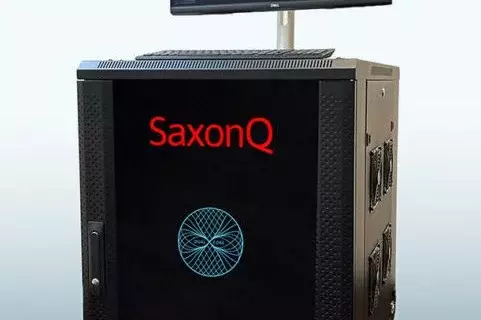
The qubits are generated using NV technology in diamond chips, which enable stable operation at room temperature, without cooling, and from any power outlet. With this new generation, SaxonQ has once again significantly improved the mobile system’s speed and performance.
Mobile Quantum Computers for Industry
The race to develop the first industry-ready quantum computer is in full swing. Startups and global technology companies are working around the clock to bring quantum computers out of the lab and into the real world. The biggest hurdles: the stability of the qubits—the computational units of the quantum computer—as well as operation in industrial environments outside of controlled lab conditions.
SaxonQ solves these challenges with qubits in diamond. A two-millimeter-small chip is the heart of so-called NV technology, a process currently used by only a few but offering decisive advantages: extreme stability and operation at room temperature. While most quantum computers require complex cooling to near absolute zero and room-filling laboratory facilities, the compact SaxonQ quantum computer runs on any power outlet.
Dual-core technology demonstrates scaling potential
With dual-core technology, SaxonQ takes a decisive step forward: Two processor cores compute together within a single system, can be controlled independently, and can thus perform parallel operations. SaxonQ thereby demonstrates that its quantum processors can potentially be expanded into multi-core systems with any number of cores. Additionally, a new readout technology has made the quantum computer significantly faster.
Co-founder and CEO Prof. Marius Grundmann: “In the race to develop the first quantum computer suitable for broad industrial use, scalability is the decisive factor. Our diamond-based qubits have been running stably in every environment for years. In the new generation, we have not only significantly increased computing power but also further improved the accuracy of the qubits and the stability of the entire system. Quantum computing is thus becoming a reality—and with us, even via the cloud.”
Managing Director Dr. Frank Schlichting: “The mere fact that we are already introducing the third generation of quantum computers in the fifth year of our company’s history is a tremendous success for our team. We’re not talking about theory here, or devices that only work in a perfect laboratory environment. We’re demonstrating that the technology will soon deliver a decisive advantage in energy supply, medical research, artificial intelligence, and many other industries. With the dual-core system, the path to a quantum computer on a chip—and thus to broad industrial application—has become a whole lot shorter.”