Zwickau: One Million Euros for Expanding Research into Safe Vehicle Electronics
Following a positive evaluation by the German Research Foundation (DFG), the German federal and Saxony's state governments are providing approximately 1 million euros in funding for the long-standing EMC research at the West Saxon University of Applied Sciences in Zwickau (WHZ).
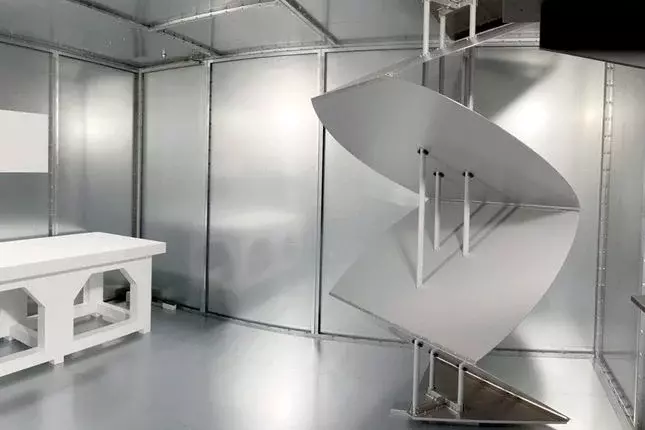
Safety requirements for modern vehicles are rising rapidly. Connected systems, automated driving functions, and new communication standards such as 5G are making electromagnetic compatibility (EMC) a key issue for the future. The West Saxon University of Applied Sciences in Zwickau is now gaining momentum in this area.
Construction of a mode-matching chamber
The focus of the funding is the development of a new EMC testing system for connected vehicle electronics. The grant consists solely of investment funds and will be used to build a so-called mode-matching chamber at the Center for Automotive Electronics (ZKE). An existing test booth was dismantled for this purpose; structural modifications are already underway. Trial operations are scheduled for June/July. In the future, the new infrastructure will enable immunity testing at the component level. The goal is to further improve the reliability of automated driving functions.
The chamber, measuring approximately 5 × 4 × 3 meters, generates a statistically homogeneous electromagnetic field and simulates real-world interference environments. This allows EMC tests to be conducted more efficiently. This is becoming particularly important in the automotive industry, as the communication systems required for automated driving functions are using increasingly higher frequency ranges, thereby further raising the demands on robust electronics.
Realistic Simulation
The “Automotive Electronics and EMC” research group at the Research and Transfer Center (FTZ) at WHZ has been working for many years on solutions to ensure that communication and drive systems operate reliably even under interference. “With the new system — consisting of a so-called mode-stirring chamber and state-of-the-art testing technology — electromagnetic influences can be simulated realistically and new measurement and testing methods developed,” explains Prof. Dr.-Ing. Matthias Richter, head of the research group.
The investment not only strengthens research at the Zwickau site but also has direct relevance for industry. The results are incorporated into international standards and help companies develop safe and high-performance vehicle technologies. In this way, the project makes an important contribution to the mobility of the future — and to the competitiveness of Saxony’s automotive region.
The FTZ e. V.
The Research and Transfer Center e. V. (FTZ) at the West Saxon University of Applied Sciences in Zwickau sees itself as an interface between science and industry. Its goal is to rapidly translate research results into industrial applications, promote innovation, and support companies in addressing technological challenges. This is based on a close cooperation agreement with the West Saxon University of Applied Sciences Zwickau (WHZ), which enables the shared use of infrastructure, expertise, and personnel. In 2025, the FTZ generated research revenue of approximately 2.58 million euros — an increase of 19 percent over the previous year.