Fraunhofer Dresden: Breakthrough in the Efficient Production of Hydrogen
Researchers at Fraunhofer IKTS in Dresden have developed a high-temperature electrolysis stack that sets new global standards: It produces hydrogen with unprecedented efficiency, can also function as a fuel cell, and is designed for industrial-scale production.
Green hydrogen is considered a key technology for decarbonizing industry. So far, efforts to achieve a breakthrough have been hampered by issues related to efficiency, cost, and scalability in production.
High-temperature electrolysis is a highly efficient process for producing hydrogen. In this process, water vapor is split into hydrogen and oxygen in an electrolyzer. The advantage: Thanks to the high temperatures, industrial waste heat can be used directly as splitting energy. This saves on expensive electricity, accelerates the electrochemical reactions, and thus optimizes efficiency.
New scientific and methodological approach by Fraunhofer IKTS
For more than two decades, researchers at Fraunhofer IKTS have been pursuing an extremely ambitious vision: to make high-temperature fuel cells and electrolysers so powerful, robust, and economical that they could not only support the energy transition but also decisively accelerate it. “From the very beginning, our goal was to build a bridge between electrons and molecules,” says Dr. Mihails Kusnezoff, Head of the Materials and Components Department and Head of the Energy Business Unit at Fraunhofer IKTS. In this regard, the Fraunhofer IKTS team’s approach differs significantly from that of many competitors: Instead of pursuing separate concepts for electrolyzers and fuel cells, the researchers developed a system that equally covers both operating environments. This is a major challenge, because while fuel cells require low resistance and high voltages, electrolysis demands long-term stable, nearly thermoneutral operation with minimal temperature gradients.
Mass-producible, universally applicable stack
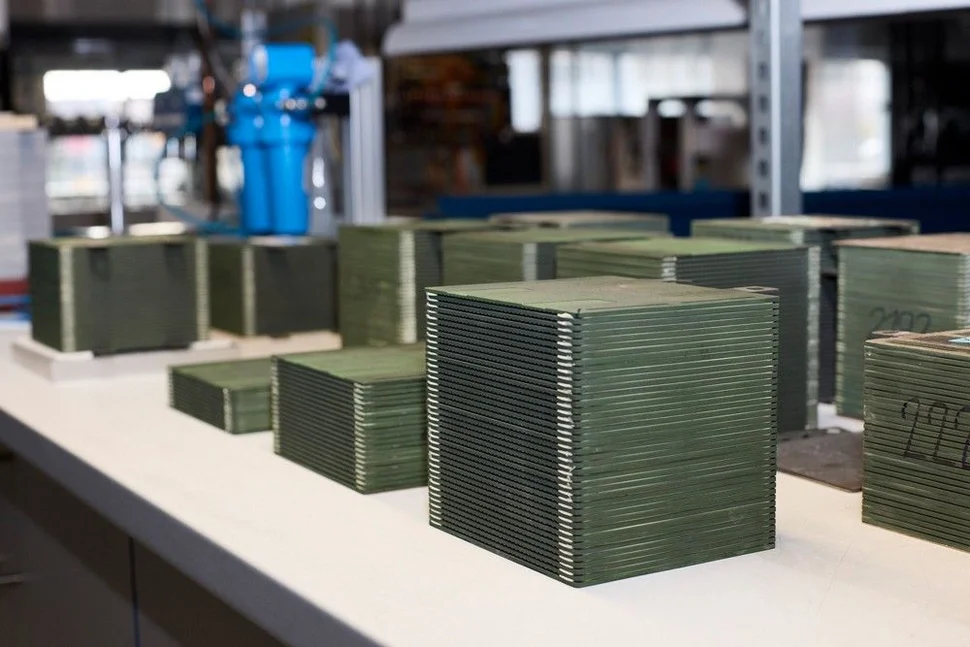
In the lab, the researchers developed new materials for the electrolyte and electrodes, optimized microstructures, and used them to build high-performance cells. “It is only the combination of many cells that creates the so-called stack—the heart of the system. It enables the necessary scaling to produce hydrogen in industrial quantities,” explains Dr. Sindy Mosch, a researcher in the Materials for Printed Systems group at Fraunhofer IKTS. The technical breakthrough was ultimately achieved through a combination of material innovation, design optimization, and consistent industrialization. “We had to learn to think of electrochemical, thermal, and mechanical effects as an integrated system. Only through the precise interplay of microstructure, sintering behavior, and protective layers were we able to develop a cell that functions reliably for years in both harsh electrolysis operation and fuel cell mode,” says Dr. Sindy Mosch.
The Fraunhofer IKTS stack operates stably within an extended temperature range of 750 °C to 850 °C—a decisive factor for the service life of an electrolyzer. In this operating temperature range, not only can water vapor and CO₂ be converted into synthesis gas via electrolysis, but various fuels such as natural gas, biogas, methanol, ethanol, or even green ammonia can also be used in fuel cell mode for power generation.
From the Lab to the Factory: Pilot Production
At the same time, the team addressed industrial scaling by redesigning the metallic bipolar plate for efficient production in a single pressing step and developing scalable coating processes for electrodes as well as contact and protective layers. “It was clear to us: a technology only contributes to the energy transition if it works in the factory and not just in the lab,” emphasizes Dr. Stefan Megel, group leader of Ceramic Energy Converters at Fraunhofer IKTS.
The technology’s industrial maturity also convinced the industry: thyssenkrupp nucera identified the developed stack as a particularly efficient and promising solution in the field of high-temperature electrolysis. Within just 14 months, Fraunhofer IKTS established an initial semi-automated pilot production line as the basis for further upscaling in collaboration with its industry partner thyssenkrupp nucera. “The pilot production demonstrates that our stacks are not only scientifically leading but also industrially manageable and economically producible—all the way up to a gigawatt-capable factory,” said Dr. Stefan Megel.
Key technology for industrial decarbonization
The stack development at Fraunhofer IKTS has not only set new standards in efficiency and technological flexibility but also forms the basis for the industrial use of electricity and waste heat for highly efficient hydrogen and synthesis gas production. In this way, the Fraunhofer IKTS team is making a direct contribution to the global energy transition while simultaneously strengthening Germany’s competitiveness as a business location.