Circular Economy at VW: First Disassembly Line in Zwickau Goes Online
The VW vehicle plant in Zwickau is opening the first industrial disassembly line with eight stations for pre-production vehicles and, in the future, for end-of-life vehicles as well.
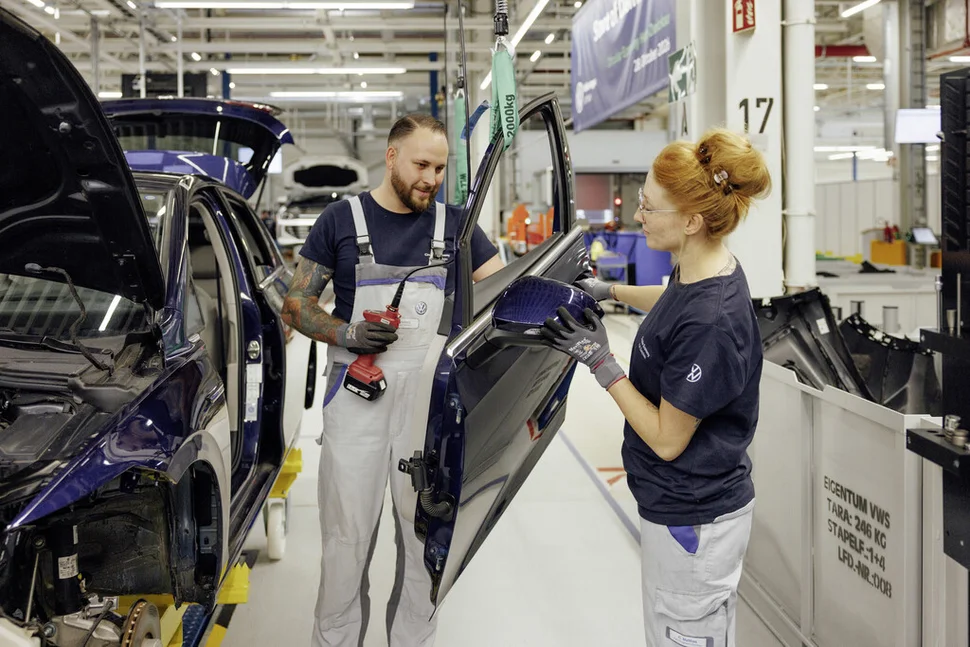
Since the project kicked off in January, the renovation work at the site and the permitting process have been completed in just nine months. Starting in 2027, 4,100 vehicles per year will be dismantled in a two-shift operation, and the facility will employ 100 workers. At the Zwickau vehicle plant, original production parts from the Group’s brands will thus be recovered and made available to dealers. In the future, the site will refurbish end-of-life vehicles, supply original components, and recover raw materials.
Thomas Schäfer, Member of the Board of Management of Volkswagen AG and CEO of the Volkswagen brand: “Starting today, we’re not only assembling cars in Zwickau, but also taking them apart again—with the same industrial precision. For us, dismantling and recycling don’t mean a junkyard; they mean creating value. This ranges from reused components to the development of new models. The team in Zwickau has tackled the topic of the circular economy with full conviction and is implementing it faster than the schedule called for. In doing so, the competence center here at the site is putting a crucial piece of the puzzle in place for the production of the future. In this way, we will advance the circular economy throughout the entire Group.”
The Volkswagen Group’s primary focus is on establishing a new business segment to tap into used parts at fair market value and material cycles. At the same time, with the introduction of recycled content quotas for plastics and other raw materials in Europe starting in 2032, industrial, scalable processes—similar to those used in vehicle production—will be necessary to efficiently dismantle end-of-life vehicles. In the plastics sector alone, it will eventually be possible to manufacture three new cars from the recycled plastic recovered from a single end-of-life vehicle.
Andreas Walingen, Head of Volkswagen Group Circular Economy: “Electric, digital, and circular: that is the automotive industry of the future. The circular economy is evolving from a sustainability concept into an industrial business model. The guiding principle here is: one vehicle. Three value streams. One business model. To implement this successfully, we need speed, scaling through industrial processes and partnerships, and innovations to ensure competitiveness. To that end, we’ve reached an important milestone in Zwickau—the start of dismantling—even faster than planned. This turns strategy into industrial reality.”
The equipment required for line-based disassembly was installed in just nine months—and, including the approval process, was completed three months ahead of schedule. In total, 1,200 square meters of flooring were resurfaced, 94 metric tons of steel were installed, and 100 meters of high-current lines for logistics processes were set up. A large portion of the investment also went toward site preparation to enable the (environmentally sound) storage of raw materials and residual materials. To make optimal use of financial resources, equipment from vehicle production was also “reused” for the dismantling process.
Danny Auerswald, Spokesperson for the Management Board of Volkswagen Sachsen GmbH: “The team at the Zwickau site is tackling this task with determination. Drawing on our expertise, we have leveraged all synergies between vehicle manufacturing and vehicle dismantling in the scaffolding and process design. Short distances on-site, technical expertise, and many years of experience among the workforce and in the region enable us to transform dismantling from a workshop-based process into an efficient, serialized process.”
In the long term, Volkswagen will establish a circular economy partner network in Europe to efficiently scale circular economy activities while optimizing logistics costs. The Zwickau vehicle plant is the center of excellence for the circular economy within the Volkswagen Group, where knowledge and expertise are pooled across all brands. This central role is further strengthened by the support of the Federal State of Saxony.
The transition to the circular economy was agreed upon for the Zwickau site during collective bargaining negotiations in December 2024. This new business division is expected to employ up to 1,000 people. Alongside vehicle production, this serves as a second pillar for securing jobs and building expertise in the Central German region. The Volkswagen Group views the circular economy as an opportunity to strengthen its competitiveness, reduce material costs and dependence on primary raw materials, and increase the resilience of its supply chains. At the same time, recycling, remanufacturing, and second-life applications can open up new market and revenue potential.