Carbon concrete: a revolution in the construction industry
It began in Dresden with intensive basic research from the end of the 20th century and the first practical projects at the beginning of the 21st century. Between 2014 and 2022, the world's largest development project on carbon concrete was coordinated from Saxony.
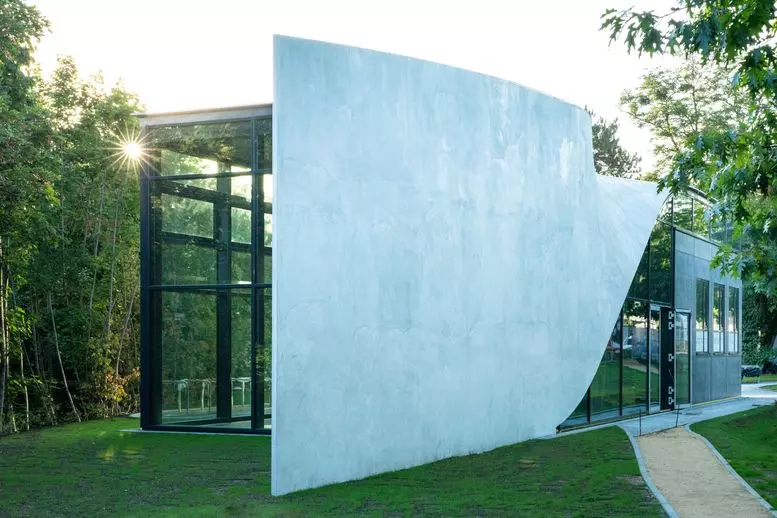
Back in 2019, the corporate network texton e. V. was founded as an association of companies in the field of fiber- and textile-reinforced concrete. The aim is to successfully use textile-reinforced concrete as a material in construction practice for the benefit of clients and contractors.
Between 2014 and 2022, the world's largest development project for carbon concrete was coordinated from Saxony - with over 150 partners and over 60 million euros for practical development. For this project, the C³ Carbon Concrete Composite Association was founded for this project - which is now the most important international association for carbon concrete construction. A large proportion of its members come from Saxony. In 2022, C³Saxony was founded as an innovation cluster funded by the Free State of Saxony.
Carbon concrete is increasingly being used in practice: in new buildings and in the field of renovation. Numerous companies and institutions are working under the umbrella brand of C³ - Carbon Concrete Composite e. V. (C³Verband) to facilitate the use of carbon concrete construction technologies, exploit the numerous advantages of carbon concrete and offer solutions for climate-neutral construction. The C³ Association currently has almost 100 members. Of these, 77% come from industry, 17% from science and 6% are associations and societies.
One of the main tasks of the C³ Association is to overcome the hurdles that still stand in the way of widespread use in a technically and scientifically underpinned manner, thus enabling broad application. The transfer of information and knowledge, technology transfer and the international expansion of activities are key aspects of the C³ Association's work. Climate-neutral construction also plays a decisive role. Carbon concrete should be perceived as a technology of the future and actively shape the change in the construction industry, which is one of the largest CO2 emitters.
The C³ Association is seeing increasing interest from the industry in using this innovative material in both the renovation and new construction of buildings, industrial plants and bridges. We alone are aware of over 250 applications with carbon concrete that have been implemented worldwide: Bridges, underground garages, parking garages, facades, roofs, silos and many other construction projects.
Milestones in Germany undoubtedly include the CUBE in Dresden as the world's first building made of non-metallic reinforcement. The bridge along the S111 in Wurschen in the district of Bautzen, whose superstructure is made exclusively of carbon concrete and which is approved for heavy goods traffic with a vehicle weight of over 40 tons, is also worthy of mention. Other current highlights include the renovation of the listed sports hall of the 49th elementary school in Dresden and the construction of a new artificial surf wave in the center of Augsburg.