Circuit boards that grow on trees?
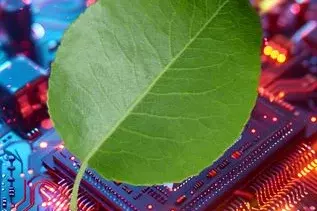
In the "UnbeLEAFable" research project, Dr. Hans Kleemann from Dresden University is focusing on an alternative solution: with the help of bio-based materials and inspired by the structure of natural leaf skeletons, his team is developing sustainable circuit boards for recyclable electronics.
Around 62 million tons of electronic waste are generated worldwide every year - a large proportion of this, around 60 percent, consists of printed circuit boards. They are part of almost every electronic device, from smartphones to computers, and connect the electronic components used in them. Conventional printed circuit boards have two problems: they are made from non-renewable raw materials and they are very difficult to recycle.
The innovation of the research at the Dresden Integrated Center for Applied Physics and Photonic Materials (DC-IAPP) lies in the fact that nature's synthesis performance serves as a model to help solve a man-made problem. The filigree vascular system of leaves is used as a natural scaffold and filled with bio-based plastics. This creates a new type of material for sustainable printed circuit boards that can replace conventional components. If this succeeds, the project can make a major contribution to a fossil-free future. On the one hand, less energy and no fossil raw materials would be required during production and, on the other, the resulting printed circuit boards would be biodegradable, meaning that the remaining components could be reused.
"The project gives us the opportunity not only to develop recyclable printed circuit boards from natural sheets, but also to completely re-explore a wide range of material and process-specific aspects towards a fully circular economy. I am looking forward to exciting years of research and development and hope that the bio-based material concepts we have invented can make a real contribution to the green transformation of our economy," says Prof. Kleemann. He heads the "Organic Devices and Systems" group at the Institute of Applied Physics and the Integrated Center for Applied Physics and Photonic Materials at the Technical University of Dresden. Together with his team, he is investigating the question of how electronic systems can be designed sustainably. His work ranges from fundamental questions of physics and materials science to process engineering research, system integration and neuromorphic computing methods.
Dresden Integrated Center for Applied Physics and Photonic Materials (DC-IAPP), TU Dresden