ELWOBOT - Robotics in fruit growing and viticulture
ELWOBOT" promises new technologies for less manual labor in fruit and wine growing. The abbreviation stands for "Electric Wine and Fruit Robot". The autonomously operating ELWOBOT machine is designed to spray pesticides, carry out maintenance work or be used for mulching, among other things.
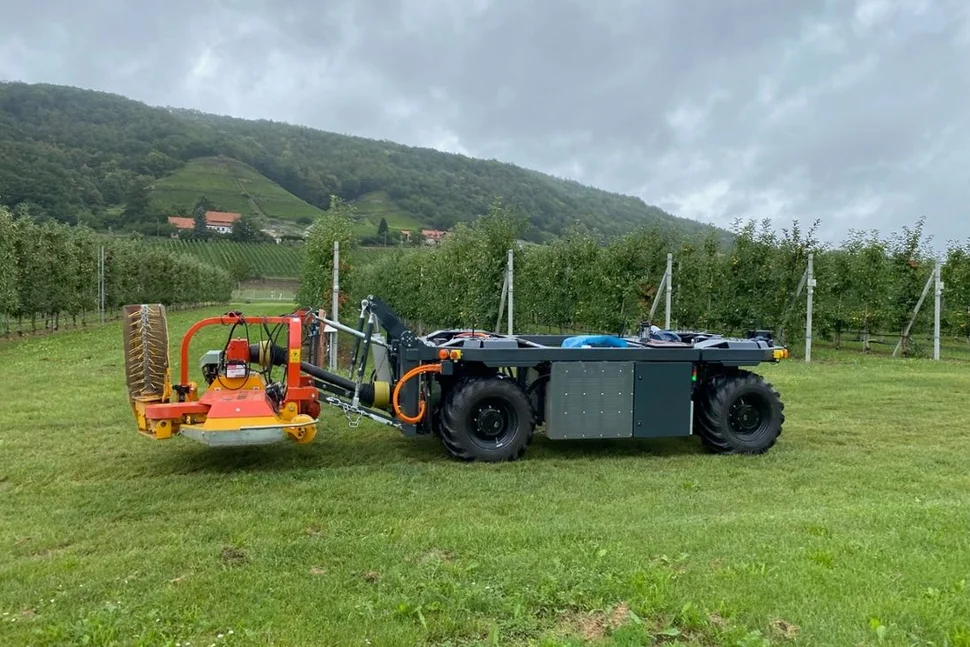
Industrial fruit production in plantations involves regular, labor-intensive and time-consuming maintenance tasks. These include plant protection, pest control and mulching the intergrowth. In Saxony's orchards, these tasks have so far been performed by portal tractors, which are able to work on four rows of trees at the same time. The increasing need to use hail protection nets requires a switch to smaller vehicles that only move within the individual rows of trees, which would quadruple the manpower required.
The Chair of Agricultural Systems Engineering at TU Dresden is therefore developing a self-propelled vehicle with partners on behalf of the State Office for the Environment, Agriculture and Geology (LfULG). It should initially be able to navigate independently in the plantation and between the rows of trees, spraying the trunks and treetops and mulching within the tramline.
The vehicle is designed for a payload of up to 1,500 kg. The chassis is based on a modular electric system with four electric individual wheel drives and individual wheel steering. The four permanently excited synchronous motors each have an installed output of 7 kW and are air-cooled. They are integrated in the wheel rim as wheel hub motors.
The power is provided by a battery-electric or diesel-electric module and can be selected according to the planned work task. For testing purposes, a fuel cell module was designed and built that can be used to recharge the battery-electric module while the vehicle is in use. This allows the use of regeneratively produced green hydrogen. The modular and scalable concept of the vehicle makes it possible to adapt it to the requirements of the orchard and vineyard.