Innovation driver for 3D system integration and wafer-level packaging
Since its foundation in 2010, the ASSID (All Silicon System Integration Dresden) branch of Fraunhofer IZM has developed into a globally recognized expert in 3D system integration and wafer-level packaging - and today plays a key role in the European technology system.
- From technology concept to industrial platform
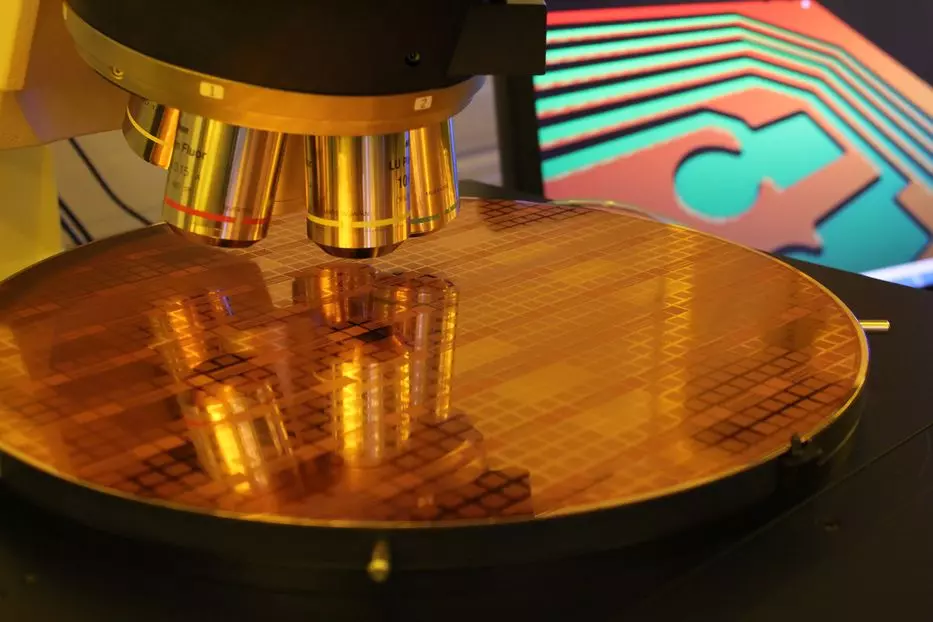
With the establishment of its Saxon branch in 2010, the Fraunhofer Institute for Reliability and Microintegration (IZM) created Germany's first 300 mm research infrastructure with an industrial-grade clean room environment, especially for 3D integration. This created a unique research campus for future technologies in the heart of "Silicon Saxony". Supported by the Federal Ministry of Education and Research, the Free State of Saxony, the EU Commission and the Fraunhofer-Gesellschaft, a place has been created where basic research is directly translated into industrial applicability.
- Technological milestones for a networked world
Numerous technological breakthroughs have been achieved in the last 15 years. Early on, Fraunhofer IZM-ASSID developed processes for through-silicon vias (TSV), multilayer redistribution layers and high-yield chip stacking. Today, the institute is working on high-precision hybrid bonding, which is indispensable for modern chiplet architectures and quantum computers.
One tangible example is the use of silicon interposers with integrated liquid cooling for the thermal stabilization of high-performance processors - an approach that is used in data centers as well as in mobile devices or future autonomous vehicles. The miniaturization of sensor platforms for medical implants, such as neuronal stimulators, has also been decisively advanced here.
- CEASAX and APECS: two key projects for Europe's technological strength
In 2024, the Center for Advanced CMOS and Heterointegration Saxony (CEASAX) was founded together with the Fraunhofer Institute for Photonic Microsystems (IPMS) in Dresden. It bundles the entire 300 mm microelectronics value chain - from design to testing - under one roof. The new 4,000 m² clean room complex in Dresden creates ideal conditions for research into neuromorphic architectures, quantum integration and edge AI.
At the same time, Fraunhofer IZM-ASSID is a key player in the APECS pilot line (Advanced Packaging and Heterogeneous Integration for Electronic Components and Systems), a core project of the EU Chips Act. Here, technologies for chiplets are being developed that offer new degrees of freedom in terms of performance, sustainability and costs thanks to their modular design. The one-stop-shop approach of the APECS pilot line gives SMEs in particular access to state-of-the-art microelectronics production - from prototype development to pre-series production.
- International cooperation, strong networks
As an active member of Silicon Saxony e. V. and partner of the Research Fab Microelectronics Germany (FMD), Fraunhofer IZM-ASSID is excellently networked - both regionally and internationally. Strategic cooperations exist with GlobalFoundries, Infineon Technologies, Siemens, NXP, imec and the CEA-Leti, among others. The connection to the TU Dresden, including via the professorship "Nanomaterials for Electronics Packaging", also ensures a close exchange between university teaching and application-oriented research.
Fraunhofer IZM-ASSID, Dresden