Mobile quantum computer goes into operation - even at room temperature
SaxonQ develops and produces mobile quantum computers. With NV technology and diamond chips, unlike many other quantum technologies, the system does not require cooling and is insensitive to vibrations.
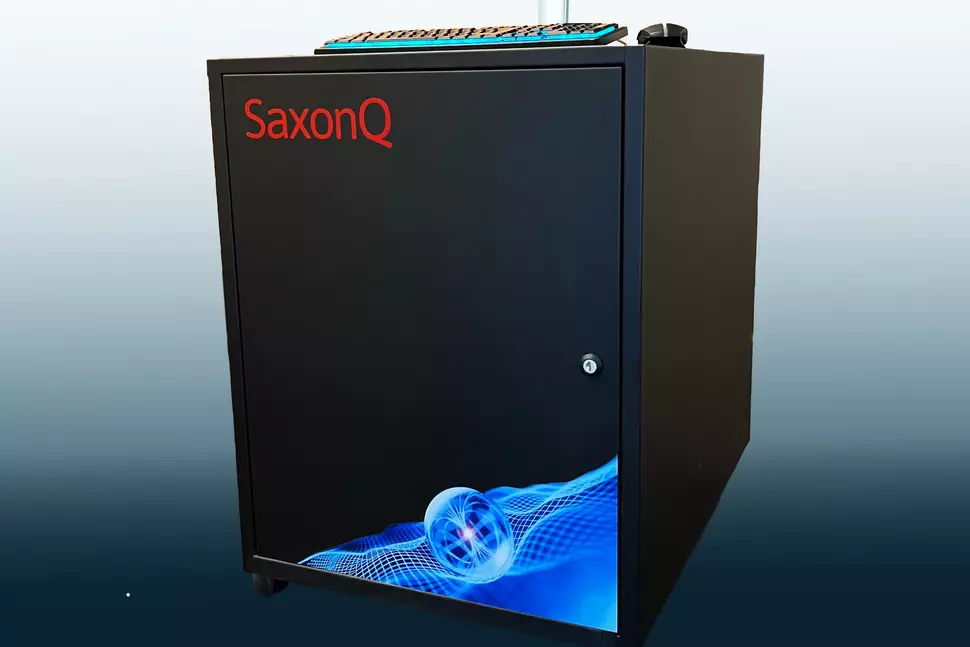
The first comparatively compact, transportable quantum computer in Saxony and one of the first in the world to operate at room temperature: a new 4-qubit quantum computer supplied by SaxonQ Leipzig has been in operation at the Dresden branch of the Fraunhofer Institute for Machine Tools and Forming Technology IWU in Chemnitz since June 11, 2025.
SaxonQ develops and produces compact, mobile quantum computers that can be operated at room temperature - a key unique selling point. The idea for the mobile quantum computer was developed by founders Marius Grundmann and Jan Meijer, who are both professors at Leipzig University. They founded SaxonQ in 2021. In principle, quantum computers are many times more powerful than conventional computers and could solve highly complex tasks in many areas in the future - tasks that would either overtax the computing power of today's computers or are not economically feasible with 'classical' computers. The development of quantum computers is still in its infancy; the devices are bulky, expensive to purchase and can usually only be operated under laboratory conditions at temperatures below -270 °C.
The quantum computer developed by the start-up SaxonQ is one of the first devices to be designed for industrial use and is easy to handle. The mobile box's processors do not require cooling or complex infrastructure and are insensitive to interference. The qubits, the computing units of the quantum computer, are generated on a diamond chip just a few millimetres in size.
"Our technology significantly lowers the barriers to entry for the use of quantum hardware and can be a real game changer for applications in AI, logistics or medical research. The first systems are already in productive use, including at the German Aerospace Center. And the scientific environment here in Leipzig, the cradle of quantum mechanics, couldn't be better for advancing quantum technologies with the best minds," explains Prof. Marius Grundmann.
Conventional quantum computers require extreme cooling down to -273 °C, ultra-stable laboratory environments and a specialized, complex infrastructure. This leads to high investment and operating costs, limited mobility and difficult integration paths into existing process chains. In addition, instability, susceptibility to vibration and complex calibrations pose major hurdles to reliable use in real production or application environments. SaxonQ addresses these challenges with its advanced NV technology. The compact, mobile unit, which will be continuously reduced in size over the coming years, can already be operated in any office via a standard power socket.
SaxonQ GmbH, Leipzig