Chemnitz researchers develop cooperating microrobots
In a decisive step towards intelligent microrobot systems, a team from the Research Center for Materials, Architectures and Integration of Nanomembranes (MAIN) at Chemnitz University of Technology has developed a new generation of autonomous microrobots.
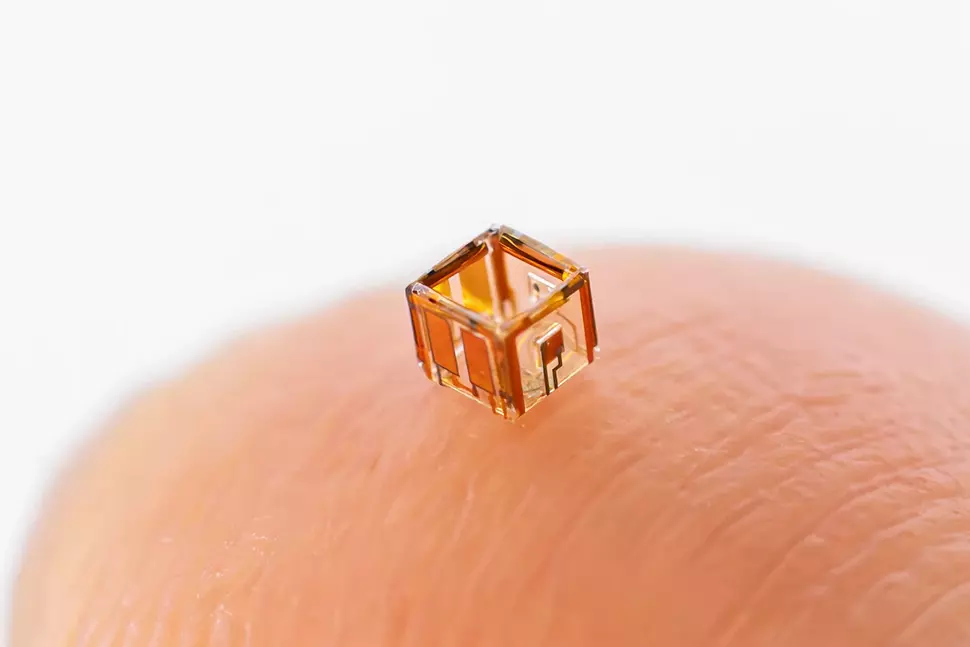
These micro-robots - known as smartlets - can communicate, act and work together in aqueous environments. Each measuring just one millimeter in size, they are equipped with integrated electronics, sensors, actuators and energy systems. They are capable of receiving and transmitting optical signals, reacting to stimuli with movements and exchanging information with other microrobots in their environment.
Unlike previous generations of microrobots, which relied on much larger wireless control systems to compensate for limited "on board" functionality, smartlet microrobots are powered by integrated photovoltaic cells, controlled by tiny microchips and capable of optical communication through embedded micro-LEDs and photodiodes. "For the first time, we are demonstrating a self-contained microrobot unit that not only responds to stimuli and moves, but also interacts with other microrobots in a programmable and autonomous way," explains Prof. Dr. Oliver G. Schmidt, one of the authors responsible for the study and Scientific Director of the MAIN Research Center.
The novel microrobots are manufactured using a flexible origami-inspired approach based on multi-functional, multi-layered structured materials. This approach allows the initially flat electronic system, fabricated in-plane on a wafer surface, to self-fold into a tiny hollow 3D cube with both internal and external functions. The origami folding creates additional space that is needed to allow each cube to carry its own solar energy harvester, computational logic and optical signaling system in addition to interacting external surfaces and its own locomotion. In water, these smartlets can move up and down using buoyancy forces generated by bubble-generating motors that fill the hollow interior of the smartlet with gas. They can also emit optical signals to transmit instructions to other Smartlets in the vicinity. Smartlets enable multi-robot interactions in water, including stimulated movement, synchronization and coordination between multiple Smartlets. When a smartlet receives a light signal, it can decode the information with its integrated processor, triggering coordinated movement or behavior in others. "The idea of using light as both energy and information opens up a compact and scalable way to create distributed robotic systems," adds Dr. Vineeth Bandari, co-author and research group leader at MAIN.
One of the key innovations is that the smartlets use a "wireless communication loop" that does not require external cameras, magnets or antennas. Optical messages are interpreted locally on each microrobot using specially programmed logic stored on their microchips. The smartlets use an innovative soft bonding technique to integrate customized microscopic silicon chiplets, called lablets, developed in an earlier European Union-funded project led by Prof. Dr. John McCaskill, a co-author and member of MAIN. This enables decentralized control and cooperation of smartlets - an essential basis for the creation of robot collectives that behave in a coordinated yet flexible manner.
The possible applications of such microrobots are manifold. Because they are wireless, biocompatible and capable of responding to environmental cues, smartlets could one day help with tasks such as monitoring water quality, performing minimally invasive medical diagnoses or studying limited biological environments. Their ability to form interactive colonies that respond to stimuli could also be used in soft robotics, autonomous inspection systems or distributed sensor networks.
By building such self-contained, communicative microrobots, the Chemnitz team is not only addressing fundamental challenges in microrobotics, but also laying the foundation for future systems that will be able to act autonomously, develop further and perhaps even organize themselves in larger networks