Hoyerswerda: Topping-out ceremony for Smart Mobility Lab (SML)
On the research campus in the Schwarzkollm district of Hoyerwerda, an impressive 42-metre-high, one-hectare research hall is being built as a research infrastructure for connected and automated mobility that is unique in Europe.
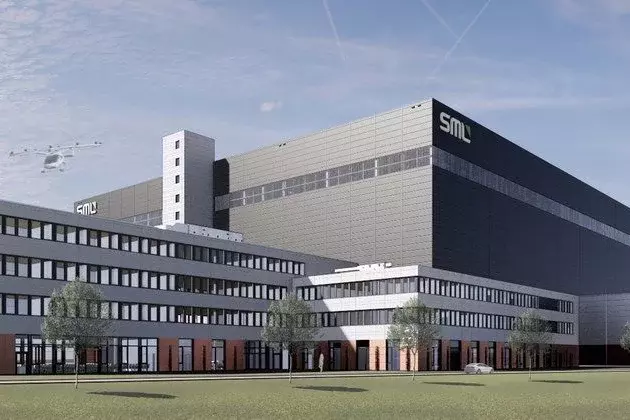
At the SML, scientists will develop new solutions for the emission-free, networked, automated and safe mobility of the future. These include projects on automated road traffic, autonomous flight systems and robot-assisted applications in agriculture.
The investment volume amounts to over 86 million euros and is primarily made up of funding from the federal government and the Free State of Saxony for structural change. The Dresden University of Technology (TU Dresden) is responsible for the construction work, which is being carried out by the company Goldbeck Ost GmbH. Construction is scheduled for completion at the end of 2026 and commissioning in January 2027.
- State-of-the-art infrastructure for the mobility of the future
The SML will serve as an interdisciplinary research platform focusing on areas such as emission-free, intelligent and safe mobility. The research center offers ideal conditions for this, including a networked research environment that realistically depicts complex driving scenarios. The research projects range from safe automated road traffic (SivaS) and autonomous flight systems (TAFAS) to robotic solutions in agriculture (FarmingSwarm-Cobots, TERECULT).
- Construction progress and schedule
Construction of the Smart Mobility Lab is progressing faster than planned. Around 1,300 prefabricated driven piles, each 20 meters long, were driven into the ground for the deep foundations in order to reliably transfer the loads of the future hall. The subsequent steel construction was carried out entirely in Saxony: All columns and trusses were manufactured in the Saxon town of Treuen; the two main trusses, each around 100 meters long and weighing 210 tons, were manufactured at Stahlbau Ruhland. Assembly took place at the end of August 2025 with the help of three large cranes.
The steel construction work has now been completed, the roof is closed and the façade work will also be finished by the end of the year, meaning that the building will achieve "structurally tight" status before the turn of the year. It is particularly noteworthy that the steel construction work was completed around two weeks earlier than planned. Structural completion is scheduled for the end of 2026 so that the building can be put into operation at the beginning of 2027.
- Future-proof energy concept too
A special feature of the Smart Mobility Lab is its innovative and forward-looking energy concept: from 2027, the building will be more than 75 percent energy self-sufficient. To achieve this, a large-scale photovoltaic system, geothermal energy, an electrolyzer for hydrogen production and a combined heat and power plant with battery and solid-state storage will be combined. TU Dresden is thus setting a strong example for sustainability and future viability not only in research, but also in building operation. Electromobility is also taken care of: in future, the university's own charging stations will be powered directly by electricity from its own energy supply.
- TU Dresden,|Campus Lusatia - Supporting structural change
Together with partners from business, society and politics, TU Dresden wants to help shape structural change in the region in order to promote ecologically and economically sustainable development and further increase the attractiveness of the Federal State of Saxony. The construction of the Smart Mobility Lab in Hoyerswerda is an example of structural development in the former lignite mining region of Upper Lusatia. In addition to expanding the urban infrastructure and creating new jobs, it is also intended to promote the establishment of start-ups and thus strengthen regional economic development as a whole.
The Smart Mobility Lab is funded on the basis of a decision by the German Bundestag and is co-financed from tax revenue on the basis of the budget approved by Saxony's state parliament. The Dresden Driving Simulator is funded by the German Federal Ministry of Digital and Transport.