Researchers from Saxony and Taiwan want to tame AI's hunger for data
With a joint research line, the Fraunhofer IPMS Dresden, the Fraunhofer IMWS Halle and the Taiwanese research institute TSRI are creating the basis for the next generation of energy-efficient AI chips - from smartphones and cars to medical devices.
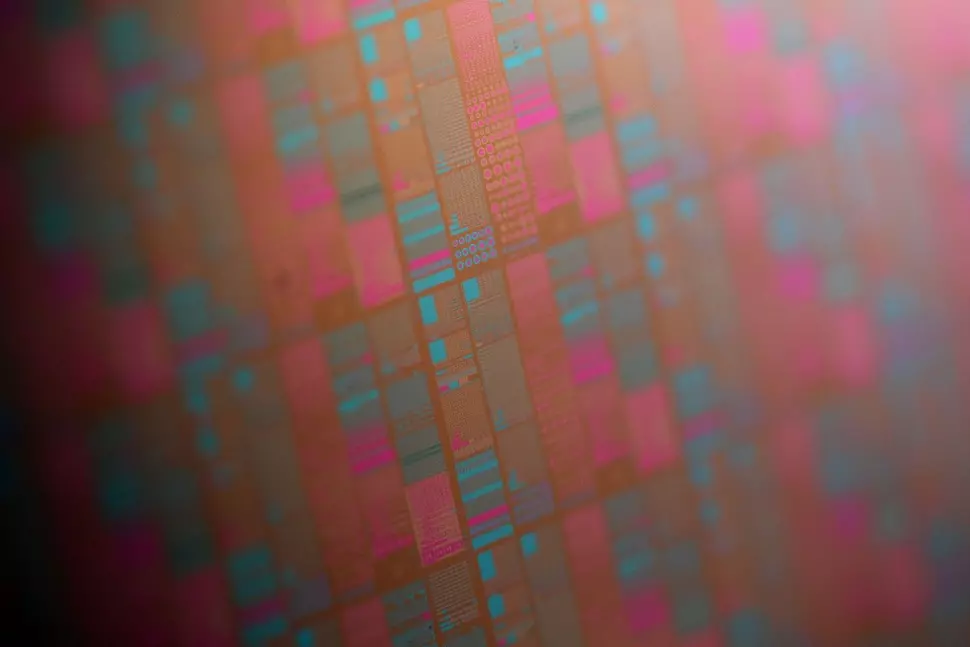
Artificial intelligence works fast, but its hunger for energy is growing rapidly. A German-Taiwanese research team is now developing a solution: new memories for the leading chip technologies smaller than 3 nm. These innovative nanosheet components enable computing operations directly in the memory and thus drastically reduce energy consumption. They are based on ferroelectric field-effect transistors (FeMFETs) based on hafnium oxide, which work particularly efficiently.
In view of the rapidly growing demand for artificial intelligence (AI) and neuromorphic computing, the energy consumption of data centers and edge systems is increasing dramatically. A key bottleneck is the transfer of data between the main memory and the computing unit. This is precisely where the joint German-Taiwanese project wants to start: A new type of storage technology should make computing "directly in the memory" possible in future, with significantly less delay and lower energy consumption.
"We are designing a platform that links memory technology and the computing power of state-of-the-art chips more closely together. This opens up new possibilities for AI systems and reduces energy consumption at the same time," says Dr. Maximilian Lederer, project manager at the Fraunhofer Institute for Photonic Microsystems IPMS in Dresden.
Ferroelectric FETs (FeFETs) based on hafnium oxide are considered particularly suitable for this purpose: Thanks to thin hafnium oxide layers, the technology can be integrated into modern semiconductor processes. In addition, these components work capacitively (instead of resistively) and therefore consume up to around 100 times less energy in embedded systems than comparable non-volatile memory solutions.
The ultimate goal of the cooperation is to establish a 300 mm research line that will develop memories not only for consumer applications, but also for automotive, industrial and medical technology.
"The German-Taiwanese collaboration combines key competencies - from material development and high-resolution material characterization to state-of-the-art device architectures. Together we are creating a platform for the next generation of energy-saving memory technologies," adds Dr. Chien-Nan Liu, Director of the Taiwan Semiconductor Research Institute, National Institutes of Applied Research (TSRI, NIAR).