VW Zwickau: Starting signal for circular economy
With immediate effect, the Zwickau vehicle plant will assume the role of central competence center for the circular economy within the Volkswagen Group. In Zwickau, new business areas of the circular economy are tested for economic efficiency, standards are set and the knowledge is made available to other locations.
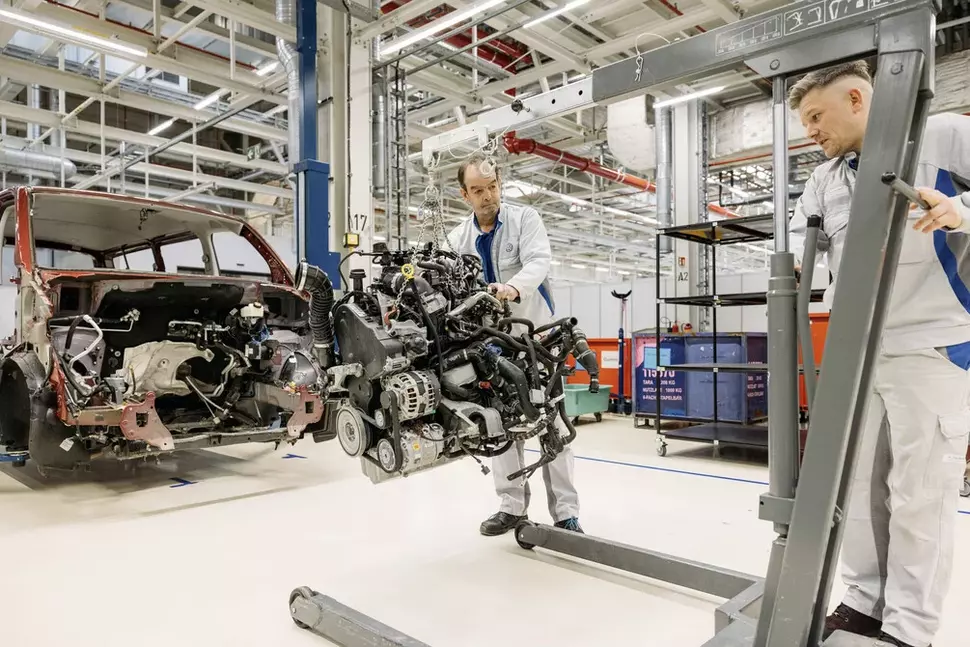
Volkswagen plans to invest a total of up to 90 million euros at the site over the next few years. The German Federal State of Saxony is funding the entire project with up to 10.7 million euros. In addition to the central function, Zwickau will initially start with the systematic dismantling of vehicles to recover valuable raw materials and reuse components. A gradual increase in capacity to 15,000 vehicles per year is planned by 2030. The implementation of the circular economy at the Zwickau site was decided as part of the collective bargaining negotiations in December 2024
The Volkswagen Group's circular economy strategy follows the "REDUCE & GROW" principle: the use of primary raw materials and emissions are consistently reduced, while at the same time new value creation, resilience and innovative business models are built up. In this way, Volkswagen secures its own value creation in the long term and develops it further - both ecologically and economically. New business models such as recycling, refurbishment (reconditioning of vehicles) and second-life applications open up additional market and revenue potential.
The Zwickau vehicle plant is taking on a pioneering role for the Volkswagen Group in the area of the circular economy. Technical innovations and the use of AI are being developed and standardized. By using data platforms and AI, Volkswagen can efficiently track and control material flows, recycling processes and business models and set new standards. In addition, Zwickau will play a central role in the training and further education of employees in the circular economy.
As a first step, the dismantling processes will be defined, tested and validated at the site in order to set standards for all other locations. This gives Volkswagen access to parts and components that can be reintroduced into the cycle, e.g. for used vehicles, after proper testing and processing. Another focus is to separate materials cleanly in order to obtain pure recyclates.
Over the next few years, up to 90 million euros will be invested in conversion work, technical equipment and AI applications at the site in order to enter the circular economy. In the current year, 500 pre-series vehicles (test vehicles) are already being processed. The number of vehicles will increase from 2027. A modular dismantling concept will allow a gradual increase in capacity to 15,000 vehicles per year by 2030. In addition to vehicle production, this business area is a second pillar for securing jobs in the long term and building up expertise in the Central German region.
Danny Auerswald, Chairman of the Board of Management of Volkswagen Saxony: "Volkswagen Saxony is once again taking on a pioneering role. We were the first plant to convert completely to e-mobility. Now we are tapping into the important business area of the circular economy. With our experience in large-scale production and the excellent university landscape in Saxony, we will examine these new business areas for the Group, present them economically and expand them."
The circular economy will play a greater role in future training occupations and university subjects. In close cooperation with the Volkswagen Training Institute in Zwickau and the West Saxony University of Applied Sciences in Zwickau, existing career paths and courses of study will be supplemented with circular economy content. This means that the Zwickau site will also be responsible for the training and further education of employees at future sites.