Fraunhofer Dresden: Ferroelectric Memory – Fast and Energy-Efficient Data Storage
Save energy, compute faster, and store data permanently: Scientists at the Fraunhofer Institute for Photonic Microsystems IPMS, in collaboration with GlobalFoundries, have developed a novel storage technology that meets precisely these requirements.
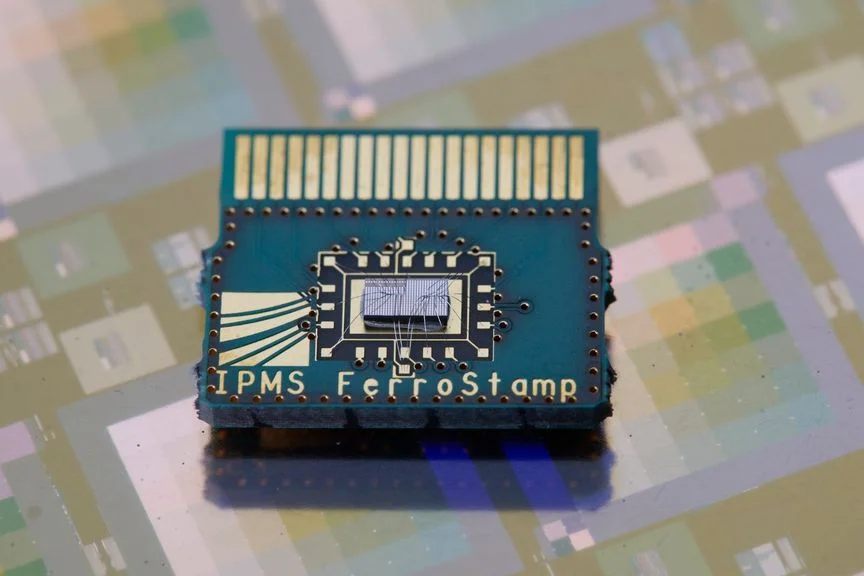
The team has succeeded in integrating ultra-fast ferroelectric FRAM memory based on hafnium oxide into an existing industrial manufacturing process. For this achievement, it has been awarded the Stifterverband’s “Forschung im Verbund” Science Prize.
Digital systems are placing ever-increasing demands on memory: it must be fast, durable, non-volatile, and at the same time extremely energy-efficient. Especially in applications in the automotive sector, industrial automation, or medical technology, existing memory solutions are reaching their limits. As part of a joint research project, Fraunhofer IPMS and GlobalFoundries have addressed this challenge and established a novel memory technology that enables energy-efficient electronics and new computing architectures.
Ferroelectric memory for permanent storage
At the heart of the work is a FRAM (Ferroelectric Random Access Memory) that uses the ferroelectric material hafnium oxide to store information permanently: “In ferroelectric memory technology, ions are shifted very rapidly within a crystal lattice, leading to a change in polarization. It is precisely this effect that can be used to store information,” explains Konrad Seidel, head of the Emerging Memory Solutions business unit at Fraunhofer IPMS. The major advantage of this method is that the information is retained even without power and can be read out as often as desired without being lost.
Integration into industrial chip manufacturing
A key success of the project is the integration of the memory into an existing industrial manufacturing technology. The researchers developed a reproducible approach to embed ferroelectric FRAM cells into GlobalFoundries’ 22FDX® technology node—a platform specifically designed for the manufacture of ultra-low-power microchips. “It’s a major step forward when you can demonstrate that what you’re intensively researching can actually be manufactured on large-scale industrial production lines,” says Dr. Franz Müller, project leader at Fraunhofer IPMS. The novel memory cells operate at energy-efficient voltages below one volt, switch in a few nanoseconds, and exhibit high endurance, meaning they reliably withstand many write and erase cycles.
Foundation for Edge AI and New Applications
The new memory technology is particularly relevant for applications where energy efficiency is crucial—such as autonomous sensors, battery-powered systems, or artificial intelligence directly in the device. “Power consumption is much lower with our non-volatile memory technology than with existing solutions. This makes it possible to deploy artificial intelligence not only in data centers but directly in edge applications where data is processed locally within the device,” explains Dr. Maximilian Lederer, Lead Scientist at Fraunhofer IPMS.
From an industry perspective, this advancement is crucial: “An affordable ultra-low-power technology with a perfectly matched memory solution is particularly attractive for applications such as edge AI. Here, two technologies come together that complement each other perfectly,” emphasizes Dr. Sven Beyer of GlobalFoundries.
Collaborative Research as a Success Factor
The project builds on a long-standing, close collaboration between Fraunhofer IPMS and GlobalFoundries at the Dresden site. Materials, processes, components, and manufacturing were developed jointly and closely integrated within the “Silicon Saxony” innovation ecosystem. “The open and trusting collaboration between industry and research was the foundation that allowed our innovation to be rapidly translated into a realistic application scenario,” says Konrad Seidel. The technology, which was rapidly brought to market maturity through combined efforts, creates an important foundation for high-performance, robust, and energy-efficient next-generation electronic systems, thereby strengthening Germany’s competitiveness in the highly competitive international market for semiconductor manufacturing technologies.