R&D with focus on timber-concrete composite construction
The aim of the project "GRO COCE - Hemp fiber-reinforced, high-performance and resource-efficient wood-concrete composite ceilings" was to develop an innovative ceiling system based on the wood-concrete composite construction method.
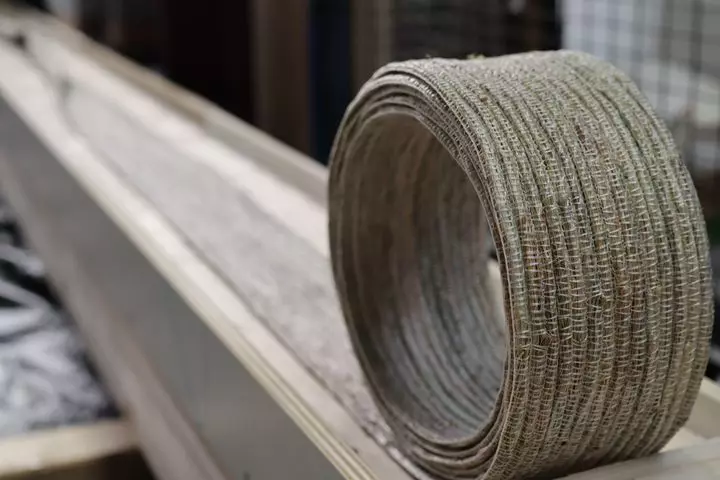
In collaboration with two companies, the Saxon Textile Research Institute (STFI) in Chemnitz and the Institute for Concrete Structures (IfB) at the Leipzig University of Applied Sciences (HTWK) conducted research on hemp-fiber-reinforced composite slabs as an economical and environmentally friendly alternative to the currently dominant, energy- and resource-intensive reinforced concrete slab constructions.
The resulting innovative floor system consists of wooden beams whose tensile zone is reinforced with high-performance hemp-fiber-based reinforcement textiles. This enables a significant reduction in the required timber cross-section and a more appropriate and responsible use of the cross-section for all standard spans in high-rise and multi-story construction. In the project, the partners developed a high-performance hemp-based semi-finished product as well as the steps for its reproducible manufacture using textile surface formation.
Single-family and multi-family homes are the beneficiaries of this innovation. A new wood-concrete composite floor (HBV floor) spanning from exterior wall to exterior wall with a span of up to 10 m is at the center of the interdisciplinary R&D project GROCOCE. The floor kit consists of wooden beams and a 7 cm thick concrete belt made of eco-concrete.
To use wooden beams with spans of 10 m, tensile zone reinforcements are required on the beams. This core challenge was solved in the project using novel high-performance laminates made from hemp bast. These exhibit a tensile modulus of elasticity of more than 40 GPa. With an innovative notch design and screw connection, this is the first HBV ceiling to allow for a clean separation of wood and concrete. HBV ceilings generate up to 50% less CO2 compared to reinforced concrete floor slabs. The new development in the form of a kit offers further advantages: demountability, involvement of regional SMEs, and CO2 reduction.
In terms of mechanical properties, particularly stiffness, strength values comparable to those of conventional glass-fiber composites (GFRP) are achieved.