Volkswagen in Zwickau, Chemnitz, and Dresden
The VW Group has been involved in Saxony for over 30 years. VW was also relying on the unique expertise of “Autoland Saxony” as part of its electromobility offensive - it started in Zwickau.
Infomodul
Facts about Volkswagen Saxony
-
May 1990
Start of production in Zwickau -
> 10,000 employees
in Zwickau, Chemnitz, Dresden -
> 7.4 million cars / 18.7 million engines
from Saxony (until 12/2024)
About Volkswagen Sachsen GmbH
The founding of Volkswagen Sachsen GmbH in December 1990 marked the start of Volkswagen AG's ambitious project to establish a competitive production facility for Volkswagen vehicles and engines in one of Germany's most traditional automobile manufacturing regions. In addition to the temporary use of existing facilities at the Zwickau and Chemnitz sites, which were completely modernized by Volkswagen, two new production facilities for vehicle and engine construction were built. The Gläserne Manufaktur Dresden was opened in 2001. In 2014, Automobilmanufaktur Dresden GmbH merged with Volkswagen Sachsen GmbH.
Since then, Volkswagen Sachsen GmbH has included the Zwickau vehicle plant, the Chemnitz engine plant and the Gläserne Manufaktur Dresden. Volkswagen Sachsen GmbH employs 11,500 people (including the Volkswagen Training Institute). Around 98 percent of the workforce have completed specialist vocational training or have a master craftsman, university or college degree. The average age is around 45 years and the proportion of women is currently 12.7 percent.
Volkswagen SachsenZwickau Vehicle Plant
The Zwickau vehicle plant covers an area of 1,800,000 square meters. That is equivalent to 252 soccer fields.
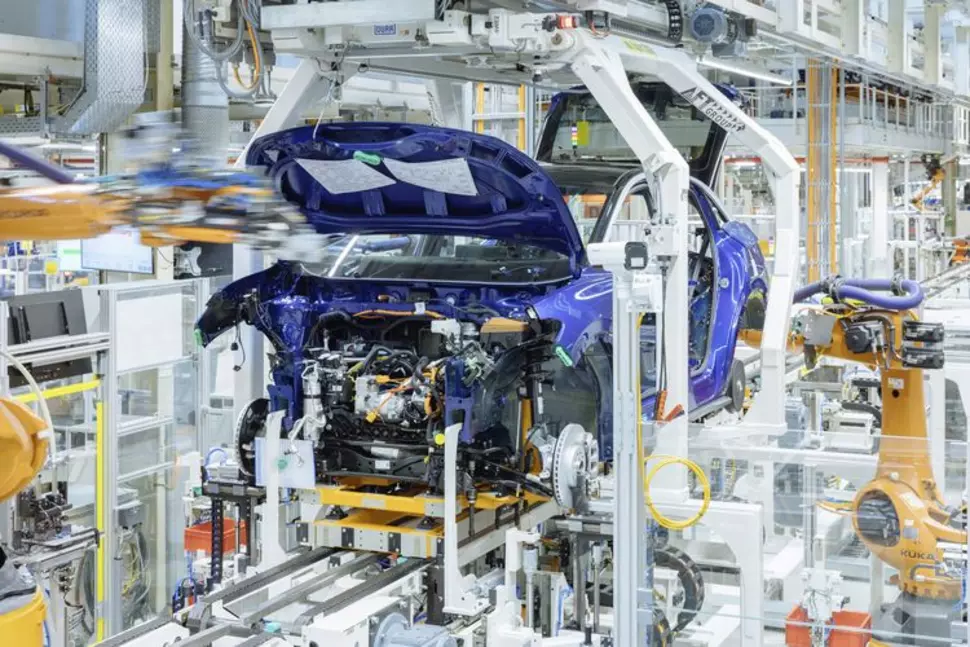
Only fully electric vehicles such as the Volkswagen ID.3, ID.4 & ID.5, the Audi Q4 e-tron and Sportback e-tron, and the Seat Cupra Born are produced in Zwickau. In January 2022, the start of production of the ID.5 completed the transformation of the Zwickau plant into a pure multi-brand electric vehicle location.
The last combustion engine vehicle rolled off the production line on June 26, 2020 – a historic milestone. In 2024, around 204,000 vehicles were produced. Since the site was established in 1990, almost seven million vehicles have left the factory halls. Zwickau played a key role in the start of production of electric vehicles: for the first time, a large car factory was completely converted to electric mobility at a cost of €1.2 billion. Six electric models for three Group brands are built in Zwickau. The bodies for the Bentley Bentayga and the Lamborghini Urus are also manufactured in Zwickau.
At the beginning of 2026, the VW plant in Zwickau will once again take on a pioneering role within the Group – as the central competence center for circular economy as part of VW's circular economy strategy. In Zwickau, new business areas of the circular economy will be tested for economic viability, standards will be set, and knowledge will be made available to other locations. Technical innovations and the use of AI will be developed and standardized. By using data platforms and AI, Volkswagen will be able to efficiently track and control material flows, recycling processes, and business models, and set new standards. In addition, Zwickau will play a central role in the training and further education of employees in the circular economy.
Volkswagen plans to invest up to €90 million in the site over the next few years. The Free State of Saxony is supporting the overall project with up to €10.7 million. In addition to its central function, Zwickau will initially start with the systematic dismantling of vehicles to recover valuable raw materials and reuse components. A gradual increase in capacity to 15,000 vehicles per year is planned by 2030.
Transparent Factory Dresden
The Volkswagen Phaeton and Bentley Flying Spur were manufactured at the Transparent Factory for 14 years until March 2016. The realignment for flexible manufacturing of various models was completed. From April 2017 to December 2020, the e-Golf rolled off the production lines. This made the Transparent Factory the first Volkswagen brand location to be completely converted to electric mobility. Series production of the ID.3 began in January 2021.
In December 2025, Volkswagen set the course for the realignment of the Transparent Factory in Dresden (GMD): Together with the Free State of Saxony and the Technical University of Dresden, the company plans to establish an innovation campus for key technology fields at the site starting next year. Over the next seven years, VW and TU Dresden will invest a total of more than €50 million in research, technology development, and four new endowed professorships. In addition, the factory will remain a delivery and research location as well as a Volkswagen experience center. Series production of vehicles at the GMD will be discontinued.
The first joint research projects on topics such as artificial intelligence, robotics, microelectronics, and chip design with TU Dresden will start in mid-2026, with regular operations beginning in 2027. In the future, TU Dresden will use just under half of the space at the Transparent Factory.
With more than 100,000 visitors annually, the factory is one of Dresden's attractions, bringing people into contact with Volkswagen products and the topic of vehicle construction. The open InnoXcampus concept aims to offer visitors insight into the future topics of automotive engineering, robotics, and artificial intelligence.
Gläserne Manufaktur DresdenChemnitz engine plant
The total area of the engine plant in Chemnitz is 213,000 square meters. This corresponds to an area the size of 30 soccer pitches. It is located directly next to the Chemnitz city park. With around 1,800 employees (including dual students and trainees), Volkswagen in Chemnitz is one of the largest private employers in the city.
The Chemnitz engine plant supplies engines to the vehicle plants and components to the Volkswagen Group's component plants. The production portfolio includes modern and economical turbocharged direct-injection petrol engines (TSI engines) as well as engine assemblies such as balancer shafts and integrated valve train modules. Within the Group, Chemnitz is the type leader for EA 211 engines (1.0 liter and 1.5 liter displacement). Each start-up of the three engines at other Group locations worldwide is supported by experts from the Chemnitz plant. More than 20 million Volkswagen engines have been produced at the Chemnitz plant since 1988. The production figure for 2024 was around 720,000 engines.
In the future, the site will also enter into the production of components for e-mobility. Thermal management has already been confirmed as the first product.
Volkswagen Training Institute, Zwickau
The Volkswagen Training Institute in Zwickau was founded on December 14, 1990 as an associated company of Volkswagen AG. Since January 1, 2013, the institute has been a wholly owned subsidiary of Volkswagen Sachsen GmbH. Today, 126 employees work here.
Since 1990, the Volkswagen Training Institute has been active at three locations in Saxony (Zwickau, Chemnitz, Crossen) for customers from various industries in the fields of vocational qualification, personnel development and organizational consulting. This includes in particular the implementation of practical vocational training, the implementation of further training measures and the provision of personnel development and organizational consulting services.
Volkswagen Bildungsinstitut